

Posted by Boswell Safe & Vault Co. on Aug 8th 2026
Safe Fire Ratings Explained: 30, 60, 90 & 120 Minute Fire Protection Compared
A safe fire rating is useful information, but the number of minutes is only one part of the story. When you compare a fire rated safe, look at the duration, the test temperature, the testing organization, the test method, the safe's construction, the door seals, the insulation and the items you plan to store. The phrase "fireproof safe" can sound reassuring, but no ordinary safe should be described as completely fireproof or guaranteed to protect every item in every fire.
This guide explains how to compare 30, 60, 90 and 120-minute safe fire ratings responsibly. It also separates fire protection from burglary ratings such as UL RSC, TL-15 and TL-30. If you are comparing models for a home, business, gun room or document-storage application, use the complete published rating for the exact model.
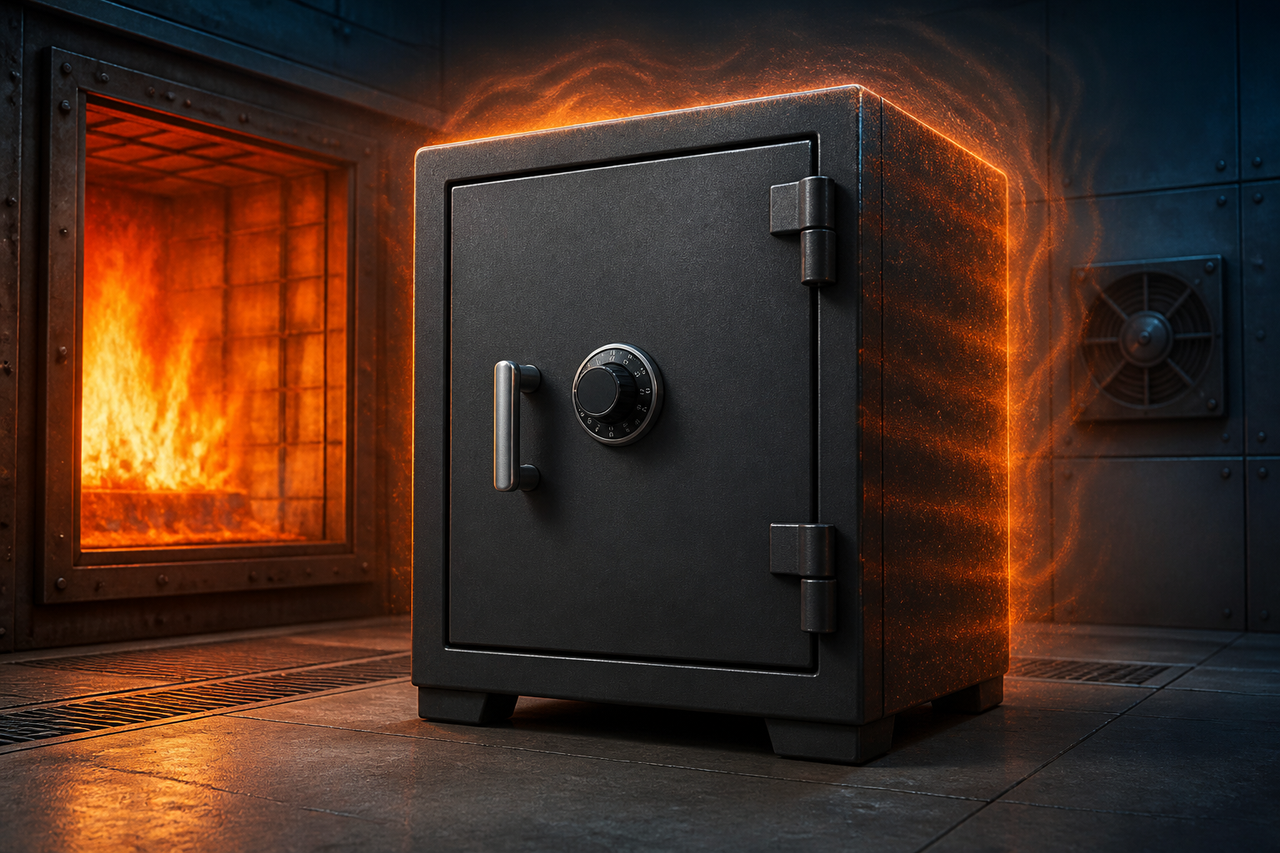
What does a safe fire rating mean?
Consider a statement such as ETL 120 minutes at 1200°F. It communicates at least three important facts:
- 120 minutes is the stated fire-test duration.
- 1200°F is the external furnace temperature identified in the rating.
- ETL identifies Intertek's testing and certification reference for that published claim.
The rating describes performance under a defined test protocol. It is not a promise that a safe will sit in any real-world fire for exactly that amount of time with every item unharmed. Fire conditions vary by fuel, ventilation, building materials, location, water exposure, collapse, impact and the time before firefighters arrive. A rating also does not tell you everything about smoke seals, water resistance, anchoring, burglary resistance, lock performance or internal organization.
Duration alone is not enough for a safe fire rating comparison. A 60-minute test at one temperature and method should not automatically be treated as exactly half as protective as a 120-minute test performed under a different protocol. Read the complete rating and the manufacturer's notes for the exact model.
Safe fire rating comparison
| Fire rating | Typical protection level | Who may consider it | Questions to ask |
|---|---|---|---|
| 30 minutes | Entry-level or economical fire-resistance claim when the complete test details are published. | Customers balancing budget, location and contents. | What temperature? Factory or independent test? What seals and insulation? |
| 60 minutes | A common step up for residential documents and valuables, with significant variation between tests. | Homes, offices and customers who need a longer protection window. | Is it UL, ETL/Intertek or factory tested? What temperature and method? |
| 90 minutes | A longer tested window often selected for higher fire-protection priorities. | Customers storing important documents, firearms and valuables. | Does the exact model carry the rating, and what is the external temperature? |
| 120 minutes | A two-hour claim under a stated test protocol; not all two-hour ratings are interchangeable. | Customers seeking stronger fire protection for higher-value or larger collections. | Who tested it? At what temperature? What is the fire curve and construction? |
| 120+ minutes / specialty protection | Specialized products or ratings that need close review of the exact standard and contents. | Businesses, collectors and customers protecting sensitive media or high-value assets. | Does the rating address your contents, and are installation and environmental controls adequate? |
Fire ratings, test temperatures and testing methods vary by manufacturer and model. Compare the complete published rating rather than duration alone.
30-minute safe fire ratings
A 30-minute rating can be an economical starting point for customers who need some tested or manufacturer-stated fire resistance in a compact safe. It may fit a smaller budget or a location where a larger, heavier safe is not practical. That does not make 30 minutes sufficient for every house fire, and it does not mean all 30-minute safes perform alike.
Think about the safe's placement, the likely response time, the amount and type of material inside, and the construction used to achieve the rating. For example, AMSEC's TF series product information identifies a 30-minute factory fire rating at 1200°F for models such as the TF5924. That is a specific manufacturer claim for a specific line, not a general promise about every economical gun safe.
60-minute safe fire ratings
One hour is a common step upward because it gives more time under the stated test conditions. Customers often consider 60-minute safes for paper documents, household records, jewelry, firearms and everyday valuables. The right choice still depends on the exact test temperature and testing organization.
AMSEC's BF models show why the complete label matters. Current manufacturer information identifies BF1512, BF1716 and BF2116 with a UL 60-minute rating at 1700°F, while BF3416 is identified with an ETL 60-minute rating at 1200°F. You can review the BF3416 example, but do not copy its temperature or testing organization onto the other BF models.
AMSEC also publishes ETL 60-minute at 1200°F information for its SF series. A 60-minute safe fire rating is therefore a category for comparison, not a single universal performance level.
90-minute safe fire ratings
A 90-minute rating creates a longer stated protection window and may be appropriate when important records, firearms or valuables deserve more fire-resistance margin than an entry-level safe. The product still needs to be evaluated by size, weight, construction, lock, anchoring and access route.
The AMSEC NF series is a useful example of a current independently tested rating: the manufacturer identifies NF models such as the NF6032 as ETL 90 minutes at 1200°F. That example is helpful because it publishes the duration, temperature and testing reference together. It should not be used to assume that a different safe with a similar name or category has the same rating.
120-minute and two-hour fire ratings
Customers who want a longer stated fire-protection window often consider 120-minute products. AMSEC's BFX and BFII gun-safe pages identify ETL 120 minutes at 1200°F. Boswell's BFX6032 example is one way to see the full rating in context, while the gun safe category lets you compare sizes and configurations.
AMSEC's CE, CEV, CF, CFX and RF high-security/composite product pages state independent 120-minute fire ratings at 1850°F. The higher test temperature is a reminder that two 120-minute claims should still be compared by temperature, test method and product construction. A two-hour rating also does not convert a burglary rating into a fire rating.
Why test temperature matters
Temperature changes the meaning of the duration. Comparing "60 minutes" with "90 minutes" without checking the temperature can hide an important difference. A 60-minute rating at 1700°F is not the same published test condition as a 60-minute rating at 1200°F, and a 120-minute rating at 1850°F is not the same statement as a 120-minute rating at 1200°F.
Also ask whether the source explains the furnace curve, the internal temperature limit, impact or explosion-hazard steps, door seals and construction. Those details help you understand what the number actually represents. They should not be replaced with a vague claim that a safe is "fireproof." If a listing gives only a number with no temperature or test reference, ask the seller or manufacturer for the missing context.
ETL vs. UL vs. factory-tested ratings
Shoppers may encounter ETL/Intertek-tested ratings, UL certifications and manufacturer or factory fire tests. ETL and UL are different organizations and programs; do not assume they are identical tests simply because both are familiar names. Read the exact label and the manufacturer's published conditions.
An ETL fire-rated safe has a testing and certification reference associated with Intertek. A UL fire rating refers to Underwriters Laboratories and the specific UL classification or test information published for that product. A factory-tested rating may still provide useful information, but the product page should make clear that the manufacturer performed or states the test rather than implying third-party certification.
When you compare an ETL fire rated safe, a UL fire rating safe and a factory-tested model, ask who performed the test, what temperature was used, how long the test ran, what internal limit applied, and whether the exact model or series is covered. A manufacturer can publish more detail than a short product card, so check the current specification sheet or official page.
Fire rating vs. burglary rating
Fire protection and burglary protection answer different questions:
- FIRE: ETL 120 minutes at 1200°F describes a fire-resistance test claim.
- SECURITY: UL RSC Level I describes a forced-entry/security classification.
TL-15, TL-30 and TL-30x6 are primarily burglary-resistance designations. RSC Level I and RSC Level II are also security classifications. A TL-30 safe does not automatically have a 30-minute fire rating, and an RSC Level I label is not a one-hour fire rating. Keep the two specifications separate when you compare safes.
What are you protecting?
Start with the contents. Paper documents, cash, jewelry and firearms have different storage priorities. Photographs can be affected by heat, smoke and moisture. Electronic media, hard drives, flash storage and digital backups can be more heat-sensitive than ordinary paper, so a paper-rated safe is not automatically a media safe.
Do not infer an internal safe temperature or a guarantee of survival unless the manufacturer publishes the relevant testing information. Keep irreplaceable digital media in more than one protected location when possible, and ask whether a dedicated data or media safe is appropriate. Capacity also matters: overfilling a safe can affect organization, door closure and access even when the fire rating itself is unchanged.
Safe placement matters too
A rated safe still needs a sensible location. Consider the ground floor versus an upper floor, nearby combustible materials, concrete or masonry, exterior walls, kitchens and fireplaces. A heavy safe can impose concentrated loads, and a large safe may need professional anchoring. The delivery path matters as much as the room: measure stairs, thresholds, doorways, tight turns, elevators and the final operating clearance.
Boswell's delivery and installation team can help review the safe's weight, dimensions, stairs, doorways, placement and bolt-down requirements before scheduling work. This is not a substitute for a structural engineer or building professional when one is needed, but it can prevent an avoidable access problem. For route and placement planning, review the safe delivery service and safe moving information.
How Boswell helps customers compare safes
Boswell Safe & Vault can help you compare the complete product picture: fire rating, burglary rating, size, weight, lock, capacity, condition, location, stairs, doorways, installation, bolt-down requirements and delivery. We can also help distinguish a published manufacturer rating from a rating that needs confirmation, especially with used safes and older models.
Before you buy, identify what you are protecting, where the safe will go, how it will get there and which testing details matter most. Then compare the exact model rather than relying on a category label or a single number.
Need help comparing safe fire ratings? Boswell Safe & Vault can help you compare models, ratings, sizes and installation requirements before you buy. Call 951-491-9921 or contact the team for product and delivery guidance.
Fire-rating questions to ask before ordering
- What is the exact fire duration and external test temperature?
- Who performed or certified the fire test?
- Does the rating apply to this model and configuration?
- What insulation, door seals and construction are used?
- Are my contents paper, firearms, jewelry, photographs or electronic media?
- What are the safe's dimensions, weight, route and anchoring requirements?
- Which burglary/security rating is separate from the fire rating?
For a deeper AMSEC-specific resource, compare AMSEC fire-rated safes and review the manufacturer's fire information. The most useful safe fire rating comparison is the one that matches the exact model, test conditions, contents and installation plan.